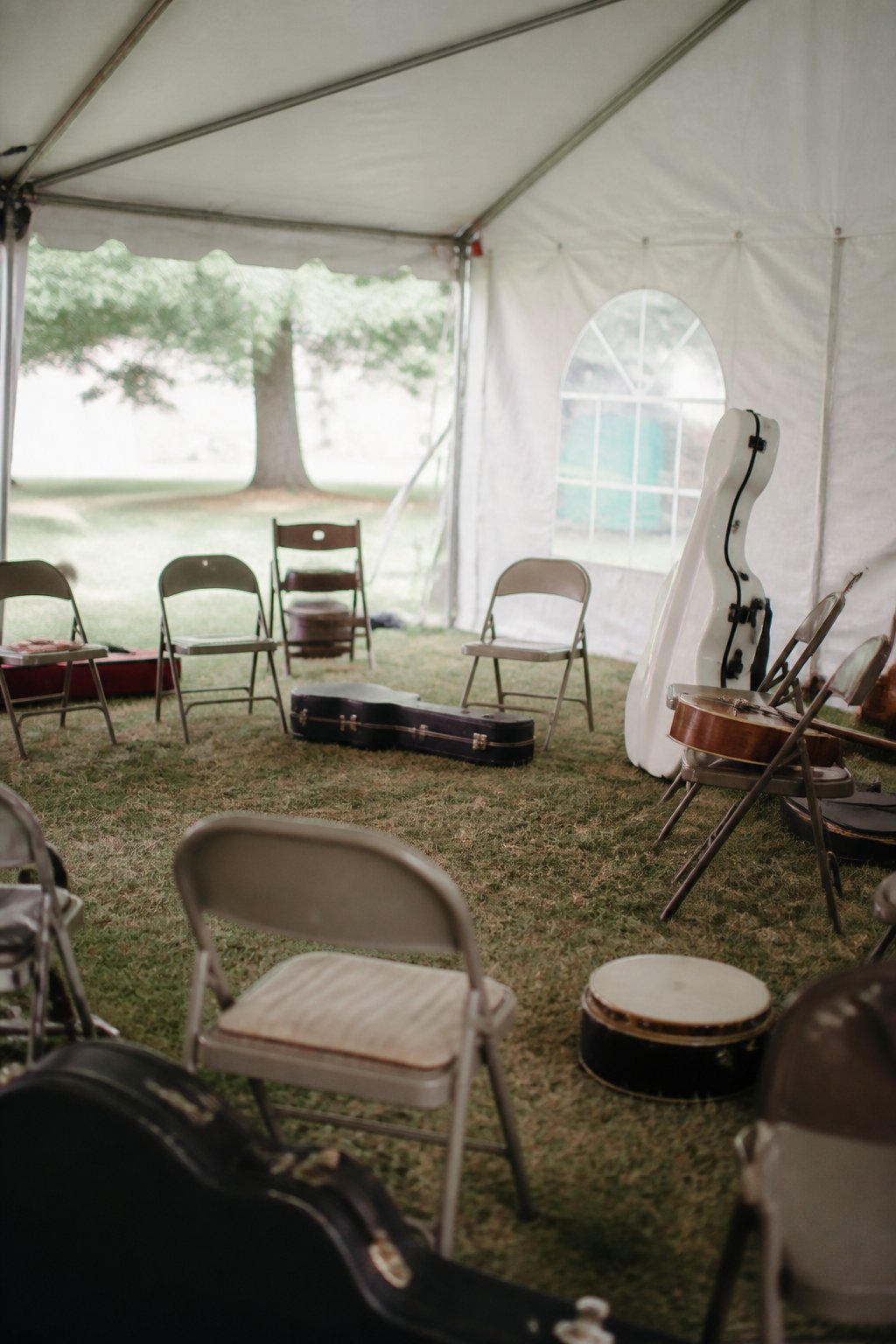
A bluegrass jam looks informal and is not. There is a shape to it, there are signals, and there is a set of rules that nobody says out loud because everybody in the circle learned them by getting them wrong once. This page writes them down, so you can get them wrong at home instead.
The circle
People stand or sit in a rough circle facing inwards, close enough to hear each other without amplification. That is not decoration. Everyone is watching everyone else for the chord changes, the breaks and the ending, and a player who stands outside the circle or faces away is cutting themselves out of the conversation.
Position matters a little. Beginners do well to sit next to the guitar player, where you can see the left hand and copy the chord shapes. Do not sit beside the loudest instrument, and if there are three banjos, spread out.
Circles have a comfortable size of about six to eight. Beyond ten, the people at the back cannot hear the singer, breaks take twenty minutes to come round, and the tempo sags. When a circle gets too big it usually splits, and splitting it is a favour rather than a rejection.
Starting a song
Whoever calls the song owns it. They name it, name the key, count it in, and either sing it or hand it to someone who will.
Say both parts out loud: Nine Pound Hammer, in G. Naming the key is not optional and it is the single most common courtesy beginners forget. Give the tempo with a clear count of four, and pick a tempo you can actually hold rather than the one on the record.
Then kick it off. In bluegrass, one instrument plays a short introduction, usually four or eight bars, that establishes the key and the speed. If you are not confident kicking off, ask someone to do it, which is entirely normal.
Taking a break
A break is a solo, and breaks pass around the circle in order, usually clockwise. Between the verses, the person whose turn it is plays the melody while everyone else drops in volume.
You are offered a break by eye contact and a nod from whoever is running the song. Two responses are acceptable: nod back and play, or shake your head, in which case it moves on instantly and nobody thinks anything of it. Refusing a break is completely normal and costs you nothing.
Three things about playing one. Start when the singer stops, not two beats later. Play the melody, especially if the song is being sung, because a break that reminds people of the tune beats a break that shows what you can do. And finish on time, on the last beat of the section, so the singer can come back in.
The signals, and what they mean
- Eye contact and a nod from the leader means the next break is yours.
- A shake of the head means you are passing. No explanation needed.
- A foot lifted, or a leg stuck out means this is the last time through. Watch for it before you plan anything clever.
- A raised hand or a flat palm usually means stop, or that the leader is about to change something.
- Fingers held up mean a number: one finger for the root chord, four for the fourth, five for the fifth, which is how a leader tells the circle where the song is going without shouting.
The six unwritten rules
- Do not tune in the circle. Tune before you sit down, and between songs turn away and use a clip on tuner quietly. Never tune while somebody else is playing, and never during a song. If you need to move a capo, do it during the chat, not the count in.
- Do not noodle. The gaps between songs are for talking, calling the next one and deciding a key. Somebody practising a lick during that gap is the most reliable way to be quietly disliked.
- Play under the singer. The voice is the loudest thing in the mix, then whoever has the break, then everyone else. If you cannot hear the singer, you are too loud, and the person who is too loud is almost never the person who thinks they are.
- Do not play lead over somebody's break. One melody at a time. Everything else is rhythm, quietly, until it is your turn.
- If you do not know the song, play less. Chords only, quietly, or nothing at all. Nobody minds a player sitting out. Everybody minds a wrong chord played confidently at full volume.
- Take your turn and pass it on. If there are four instruments and eight verses, that is two breaks each, not five for you. Watch who has not played and offer.
The fastest route to being welcome in any circle is to be the person who plays quietly, keeps perfect time and passes the break to somebody who has not had one yet.
When you do not know the tune
Which is most of the time in your first year, and it is fine. Bluegrass harmony is overwhelmingly built on three chords, the one, the four and the five, and most songs telegraph their changes.
Watch the guitar player's left hand. Learn to recognise the shapes for the main chords in the common keys and you can follow almost anything within a verse. Listen for where the change lands, which is usually at the end of a two bar phrase. Play very quietly until you are certain, then come up in volume.
You will also hear people call chords by number rather than name, one, four and five instead of G, C and D, so that the same shorthand works whatever key the singer needs. It takes an evening to get used to and then it is obviously better.
The standards are worth learning deliberately, because they come up everywhere: Nine Pound Hammer, Salt Creek, Old Home Place, Man of Constant Sorrow, Will the Circle Be Unbroken, Angel Band, Cripple Creek, Blackberry Blossom. Twenty songs you can play without thinking will carry you through any jam in these islands.
Slow jams, and finding one
A slow jam is a circle run deliberately below normal tempo so that learners can join, usually with somebody calling chords out loud. Most festivals now run one, and a lot of regional bluegrass associations run monthly sessions with a slow circle in a separate room.
Use them without embarrassment. They are not a lesser version of the real thing, they are the training ground for it, and experienced players who turn up to help are doing it on purpose. If you have never played with other people, do a slow jam before you attempt a campsite circle at midnight.
The festival calendar notes which events run them, and any of the camping weekends will have one going by Saturday afternoon.
An Irish session is not a bluegrass jam
Worth saying clearly, because on this island you will end up in both, and the rules are different in ways that cause genuine offence.
An Irish traditional session plays tunes in unison. There are no breaks, no solos and no rotation. Tunes come in sets of two or three, run together, and whoever starts a set decides what follows. Chordal accompaniment is a specialist role and one guitar or bouzouki is usually enough for the whole room, so a second one strumming along is not welcome. Nobody sings over the tunes, and songs, when they happen, are usually unaccompanied and the room goes quiet.
The practical translation: at a bluegrass jam, play rhythm and wait for your break. At an Irish session, play the melody if you know it and sit still if you do not.
Common questions
What do I do at my first bluegrass jam?
Arrive tuned, sit beside the guitar player, play rhythm quietly, and refuse the first break you are offered if you are not ready. Nobody expects a new player to solo, and nobody minds.
How do I know when a song is ending?
Watch the person who called it. A lifted foot or a leg stuck out means this is the last time through, and the ending is usually a standard tag phrase everyone joins. When in doubt, stop when the guitar player stops.
Can I bring a drum or a cajon to a bluegrass jam?
Usually not, and asking first is wise. The mandolin chop and the guitar already supply the percussion, and an added drum takes the flexibility of tempo away from the circle. It varies by group and by country, so read the room.
Is it rude to refuse a solo?
Not at all. A shake of the head is a complete answer and the break moves on within a beat. Experienced players refuse breaks all the time when a song does not suit their instrument.
How loud should I play?
Quieter than you think. The rule of thumb is that you should be able to hear the singer clearly at all times, and if you cannot, you are part of the reason. Volume in a jam is a shared resource.
Where to go next
- Bluegrass festivals in Ireland and Britain, where the campsite jams run until the small hours.
- Using a capo, and the fifth string problem, because changing key quickly is a social skill in a circle.
- Flatpicking guitar from scratch, the instrument everyone else in the circle is following.
- The five string banjo, explained properly, if you are the person everyone keeps asking to play quieter.