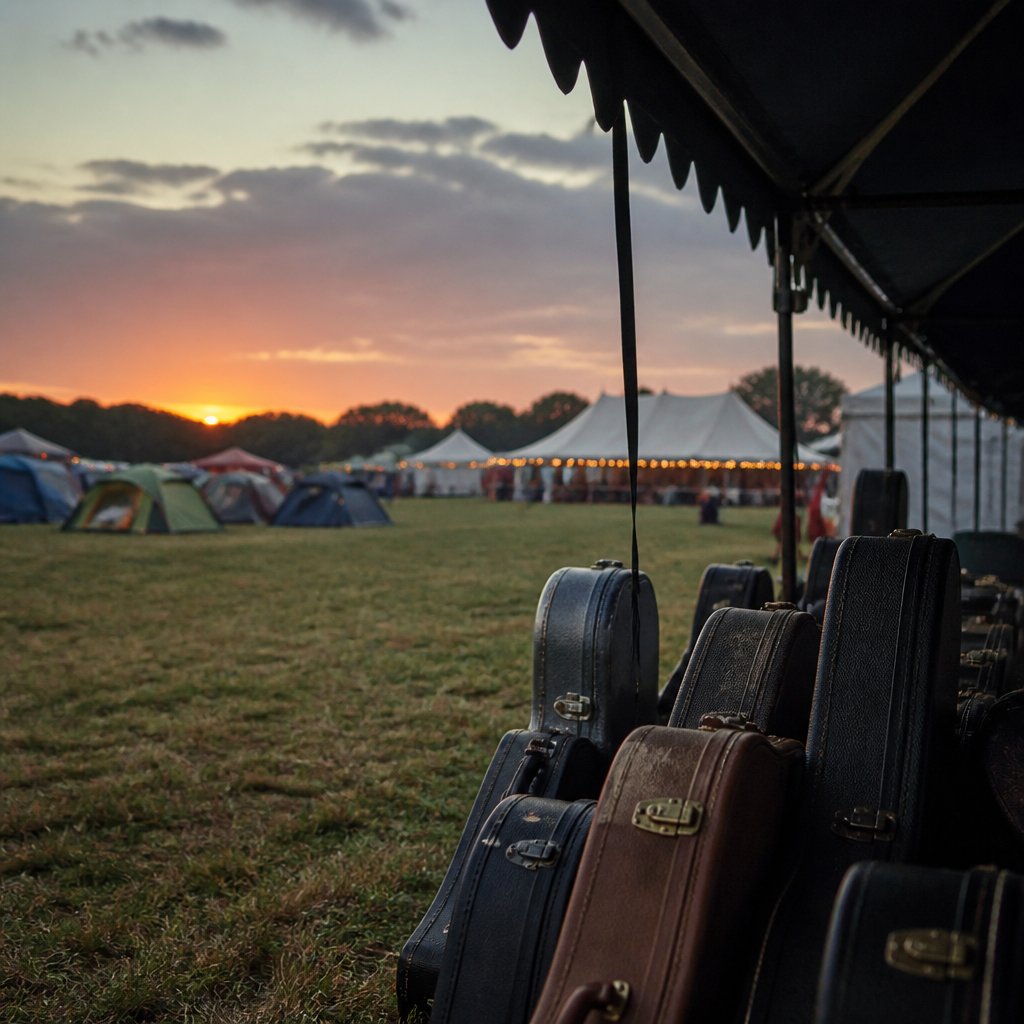
The bluegrass year on these islands is short, it is mostly held outdoors, and it is built almost entirely by volunteers. There is no touring circuit in the American sense and there is no season ticket. What there is instead is a run of long standing weekends between Easter and the end of September, nearly all of them attached to a campsite, a hotel car park or a village hall, where the stage is the smallest part of the event.
This page is a map of the shape of that year rather than a listings service. Weekends move, venues change, committees run out of steam and events do skip a year, so treat every line below as a rough position in the calendar and confirm with the organisers before you book a ferry or a pitch.
How the year is shaped
Four things drive the dates. Easter opens the season, because the one full week of tuition in these islands has always sat there. Late June and July belong to Ireland, where the festivals are small, hotel based and famously easy to walk into. Late August and early September are the busiest fortnight of the whole year, with the two biggest gatherings on either side of the Irish Sea usually landing on the same weekend or a week apart. After the end of September it goes quiet, and the music moves indoors to house sessions, workshops and a handful of one day events.
Almost nothing here is a big stage festival. A typical weekend is a field or a hotel with two or three hundred people, a stage running from mid afternoon to late evening, workshops on the Saturday morning, and jams that start when the stage stops and finish when the last person gives up. If you have only been to the arena kind of festival, the scale is a genuine surprise: you will end up talking to the people who played, usually in a queue for tea.
Ireland and Northern Ireland
| Event | Where | Usually | Shape of it |
|---|---|---|---|
| Kilkenny Rhythm and Roots | Kilkenny city | Late spring | Americana rather than strict bluegrass, spread across pubs in the city with a lot of free gigs |
| Westport Folk and Bluegrass | County Mayo | Early summer | Town centre pub venues, folk and bluegrass side by side, very informal |
| Athy Bluegrass Festival | County Kildare | Midsummer | One of the oldest bluegrass weekends in Europe, hotel based, camping alongside |
| Dunmore East Bluegrass | County Waterford | High summer | Seaside village weekend, small stages and harbour side sessions |
| Appalachian and Bluegrass, Ulster American Folk Park | Near Omagh, County Tyrone | Early September | The largest gathering on the island, played among reconstructed emigrant buildings |
| Johnny Keenan Banjo Festival | Longford town | Early autumn | Banjo centred, Irish and American traditions in the same programme, has run intermittently |
| Bruff Bluegrass Festival | County Limerick | Autumn | Small late season weekend, indoors, strong local jam following |
The Omagh weekend is worth explaining, because the setting is the point. The Ulster American Folk Park is an open air museum about emigration from Ulster to North America, with a rebuilt Ulster street on one side of the site and a rebuilt Pennsylvania street on the other. Bluegrass played between those two streets is not a themed novelty. It is the shortest way anyone has found to show what actually happened to this music: it left with people, changed, and came back.
Nobody goes to an Irish bluegrass weekend for the headliner. They go because eleven people they only ever meet in September will be in the same car park on Saturday night.
Britain
| Event | Where | Usually | Shape of it |
|---|---|---|---|
| Sore Fingers Summer School | Oxfordshire, England | Easter week | A full week of tutored classes by instrument and level, with tutors flown in from the United States |
| Cornish Bluegrass Festival | Cornwall, England | Late spring | Bank holiday camping weekend at the far end of the country, family heavy |
| Orwell Bluegrass Festival | Suffolk, England | Late summer | Campsite festival in the east, known for jams that run all night |
| Didmarton Bluegrass Festival | Gloucestershire, England | Early September | Field, campsite and a jam tent that is busier than the main stage |
| Moniaive Michaelmas Bluegrass | Dumfries and Galloway, Scotland | Late September | Village scale, hall and pub venues, closes the outdoor season |
Sore Fingers is the odd one out and the one most worth planning a year around. It is not a festival at all: it is a residential school where you are placed in a class for your instrument and your level, taught every morning and afternoon for the week, and left to jam in the evenings. People who go once tend to go for a decade. If you are the only banjo player you know, a week of being one of fifteen is worth more than any number of Saturday afternoons in a field.
For dates as they are confirmed, the two community sources everyone actually uses are the Bluegrass Ireland Blog, which has tracked Irish dates and gigs for years, and the British Bluegrass Music Association, which keeps the British listings and publishes a members' magazine. Neither pays us anything and neither knows we exist.
Worth the ferry
Two continental events pull players from these islands every year, and both are easier to reach than an American festival.
| Event | Where | Usually | Shape of it |
|---|---|---|---|
| European World of Bluegrass | Netherlands | Late spring | Showcase weekend for European bands, plus the trade side of the scene |
| La Roche Bluegrass Festival | Haute Savoie, France | High summer | The biggest camping bluegrass festival in Europe, week long, Alpine setting |
What actually happens on the weekend
The programme on the poster is roughly a third of the event. Here is the rest of it.
- Workshops. Usually Saturday morning, usually free with the ticket, usually one per instrument. They are pitched at improvers and they are the best value on the site.
- The slow jam. Many festivals now run a deliberately slow session, often early afternoon, specifically so that beginners have somewhere to go. If it exists, use it. It is not a consolation prize.
- Open jams. These form and dissolve on their own from late afternoon onwards, in the campsite, the bar or the car park. The unwritten rules are the same everywhere, and we have written them down in how a bluegrass jam actually works.
- The band scramble. Names into a hat, random bands drawn, forty minutes to rehearse, everyone plays. It is exactly as terrifying and as good for you as it sounds.
- The instrument tables. Small makers and repairers turn up at the bigger events with a table. You will learn more in twenty minutes there than in a month of reading forums.
Packing list for a camping weekend
- A second set of strings for every instrument you bring, and a peg winder.
- A clip on tuner and a spare battery. Tuning by ear in a field with four jams going is not realistic.
- A capo and, for banjo players, whatever you use for the fifth string. See the capo guide if that sentence made no sense.
- Warm layers. September nights in a field in Tyrone or Gloucestershire are cold at two in the morning, which is when the good jams happen.
- A folding chair. Jams form in circles and standing up for three hours will end your weekend early.
- Twenty songs you can play without thinking. Far more useful than fifty you half know.
Going for the first time
Buy a day ticket before you commit to the full weekend, and choose the Saturday. Arrive in the afternoon rather than the evening, because jams in daylight are far easier to join than jams at midnight. Bring your instrument even if you are certain you will not play it, because the certainty rarely survives the first afternoon.
If you are travelling from Ireland to a British event, or the other way, remember that instruments count as fragile hand luggage on the ferry and as an argument at the airport. Ferries are calmer and cheaper for anyone bringing a resonator guitar or a double bass, and most of the campsite regulars drive for that reason.
One social note that surprises people: at these events, being a beginner is a normal thing to be, and saying so out loud is the fastest way to be looked after. Nobody minds a slow player. The one thing that irritates a circle is somebody playing loudly over a tune they do not know.
Common questions
When is the bluegrass season in Ireland and Britain?
Easter to late September. The Easter week is taken up by the residential summer school in Oxfordshire, the Irish weekends cluster in June and July, and the two biggest events on either island usually fall within a fortnight of each other in early September.
Do I need to be able to play to enjoy a bluegrass festival?
No. Plenty of people come to listen, and every event has a bar, a stage programme and a campsite. If you do play, even badly, you will get far more out of it, because the jams are the real event.
Are these festivals expensive?
They are among the cheapest music weekends you will find, because they are run by committees rather than promoters and the camping is usually included or close to it. The residential school is the exception, since it is a week of tuition rather than a festival ticket.
Can I bring children?
Most of the camping events are strongly family oriented and some run children's workshops. The pub based Irish weekends are the ones to check first, because licensing hours limit where under eighteens can go in the evening.
What should I do if I only play a bit?
Find the slow jam, sit in the outer ring, and play rhythm. If there is no slow jam, ask the guitar player in a small circle what key they are in and stick to chords. Read the etiquette page first and you will be ahead of half the field.
Where to go next
- How a bluegrass jam actually works, the six unwritten rules, before your first campsite circle.
- The five string banjo, explained properly, if the weekend has convinced you to start.
- The fiddle, the instrument that connects an Irish session to an Appalachian one.
- About this notebook, who writes it and why there is nothing for sale on it.