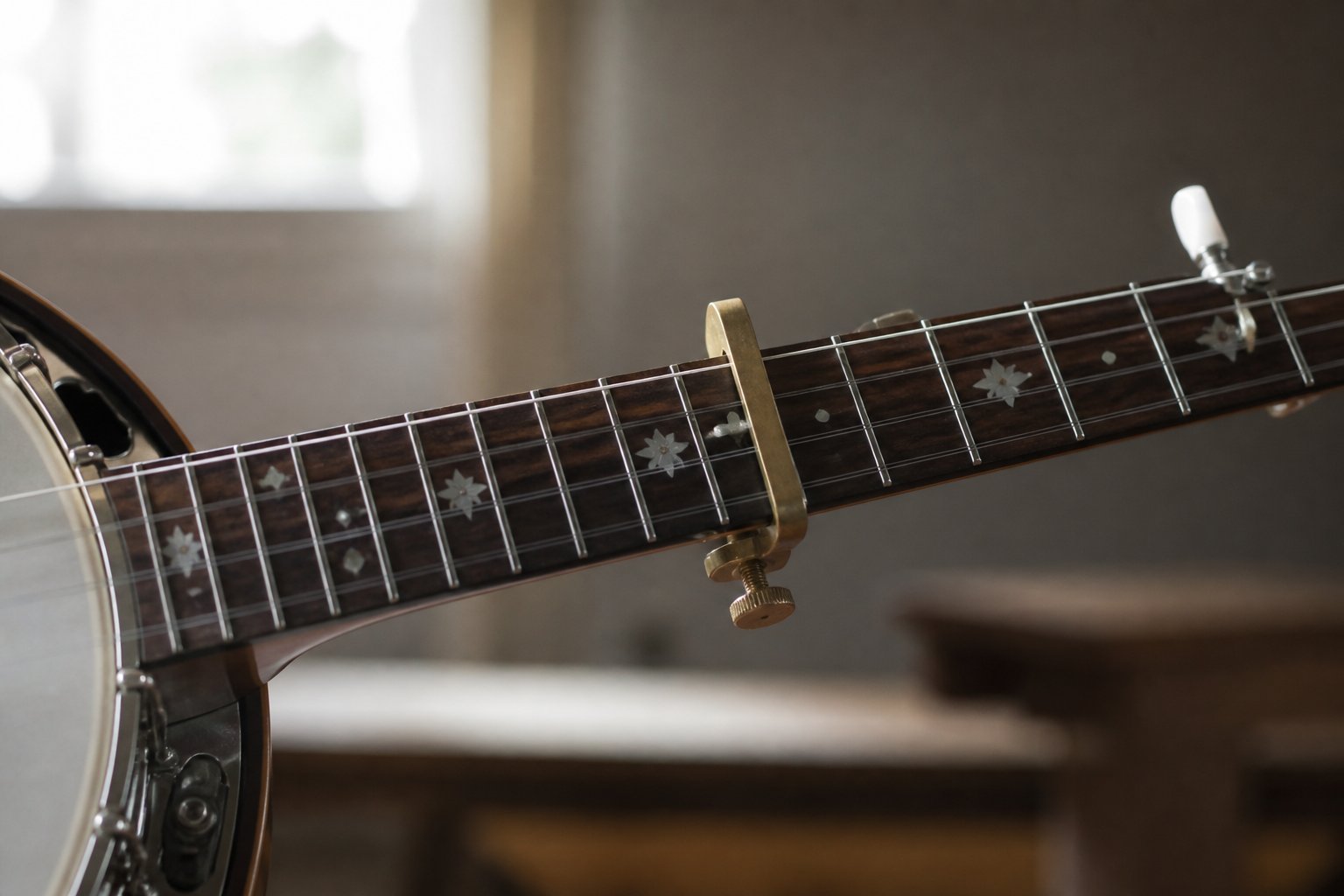
A capo shortens every string it clamps, which raises the pitch and lets you keep playing the shapes you already know in a different key. On a guitar that is the end of the story. On a five string banjo it is four fifths of the story, because the fifth string starts at the fifth fret and no ordinary capo can reach it.
This page covers what a capo is for, the three standard solutions to the fifth string, the fret to spike for each key, and how to fit one without going out of tune.
Why banjo players capo at all
Because the rolls depend on open strings. In three finger playing, a large part of every pattern is unfretted: the fifth string drone, the open third, the open first. Move to a different key by using different chord shapes and all those open strings become wrong notes, and the roll patterns that took you a year stop working.
Capoing keeps the shapes and moves the instrument instead. A singer says the song is in B flat, you clamp at the third fret and play exactly what you would have played in G. This is why bluegrass banjo players own capos and mandolin players, whose chord shapes use no open strings at all, generally do not.
Old time playing takes the other road more often, retuning the whole instrument rather than clamping it, though plenty of players do both at once: capo at two and retune the fifth string to match.
The fifth string problem
Clamp a capo at the second fret. The fourth, third, second and first strings all rise by a whole tone and your G shapes now produce A. The fifth string, which begins at the fifth fret and passes over its own small nut, is behind the capo and completely unaffected. It is still a g, and it is now sounding against an A chord every time your thumb touches it.
It sounds wrong immediately. Not subtly wrong: the drone is the most constantly repeated note on the instrument, and against the wrong chord it fights everything.
The three fixes
- Retune it. Turn the fifth string peg up to the new note. Free, instant, needs no modification, and it works perfectly well for one or two songs. The cost is wear: that string is short and thin and repeatedly stretching it shortens its life considerably. It also drifts for a minute afterwards.
- Fifth string spikes. Small model railway spikes, fitted into the fingerboard beside the fifth string by a repairer, usually at the seventh, ninth and tenth frets. You slip the string under a spike with a fingernail and it holds the string down at that fret. This is what most bluegrass players use: it takes two seconds, holds tuning and costs very little to have fitted.
- A sliding fifth string capo. A rail screwed along the side of the neck with a clamp that slides to any fret. More flexible than spikes, more expensive, and it requires drilling into the neck, which some players will not accept on a good instrument.
Which fret, which key, which spike
| Capo at | Key | Fifth string | Spike at |
|---|---|---|---|
| No capo | G | g | None needed |
| 2nd fret | A | a | 7th fret |
| 3rd fret | B flat | b flat | 8th fret |
| 4th fret | B | b | 9th fret |
| 5th fret | C | c | 10th fret |
| 7th fret | D | d | 12th, if fitted |
The rule underneath the table is simple: the spike goes five frets above the capo, because the fifth string starts five frets up the neck. Most players have three spikes fitted, at seven, nine and ten, which covers A, B and C. The eighth fret spike for B flat is worth adding if you sing with anyone who likes flat keys, which in practice means anyone who plays with a fiddle or a horn.
Above the fifth fret, most banjo players stop capoing and change approach instead. For the key of D, many play out of open G position with no capo and use D shapes, or capo at seven if the instrument is comfortable that high, which not all are.
A capo at the second fret with the fifth string still at g is the most common wrong note in bluegrass, and the player making it is usually the only person in the room who cannot hear it.
Fitting a capo without going out of tune
Three types are in general use. A spring clamp goes on with one hand and is the fastest, but the pressure is fixed and it can pull the strings sharp. A screw capo takes longer and lets you set the pressure exactly, which is why players who capo once per set prefer them. Elastic capos are cheap and hard on tuning.
Whichever you use, the technique is the same.
- Place it just behind the fret, on the headstock side, almost touching the fret wire. Too far back and you get buzzing and a stiff feel.
- Use the least pressure that stops the buzz. Over tightening bends the strings sideways and pulls the whole instrument sharp, most audibly on the third string.
- Keep it square across the neck. A capo at an angle presses harder on one side.
- Retune after fitting, every time. Check the third and second strings first, since those move most.
- Take it off between sessions. A capo left clamped on for weeks marks the neck and keeps the strings under uneven tension.
In a jam, this is the whole routine
Somebody calls a song in B. Clamp at four, hook the fifth string under the ninth fret spike with a fingernail, check the second and third strings with a clip on tuner, and nod. Ten seconds if you have done it fifty times, and everybody in the circle will wait for those ten seconds without complaint. What they will not wait for is tuning from scratch, which is why capo positions are worth practising at home.
Do spikes damage the instrument
Fitted properly, no. They are tiny, they sit beside the fifth string where the hand never goes, and they have been standard on bluegrass banjos for decades. They are not a modification anybody worries about on a working instrument, and they do not affect resale value in the banjo world, unlike on a vintage collector's piece where any drilling matters.
They should be fitted by a repairer. The holes are small and go into a thin edge of the fingerboard, and a slip splits wood that is awkward to repair invisibly.
The sliding capo is a bigger decision because the rail is screwed to the side of the neck. On a modern instrument, fine. On anything old or valuable, think twice, and use the spikes.
Common questions
Do I need a capo to play the banjo?
Not on your own. The moment you play with a singer, you need one, because singers choose keys to suit their voice and B flat is far more common than beginners expect.
Can I use a guitar capo on a banjo?
Yes, most guitar capos fit a banjo neck, which is narrower and often thinner. Banjo specific capos are simply shorter. Check that the clamp does not overhang and touch the fifth string.
What do I do about the fifth string without spikes?
Retune it by ear each time you capo. Use the table above for the note you need, tune it against the fretted equivalent on another string, and expect it to drift for a minute.
Why does my banjo sound out of tune after I capo?
Almost always over tightening, which pulls the strings sideways and sharp. Loosen the capo to the least pressure that stops the buzz, and retune before you play rather than after somebody winces.
Should old time players capo or retune?
Both, and often together. Old time repertoire lives in tunings such as double C and sawmill, and a capo is then used on top to move that tuning to another key without losing the relationships between the strings. The tunings themselves are listed in the tuning guide.
Where to go next
- How to tune a five string banjo, the notes you are moving and the alternate tunings behind them.
- The five string banjo, explained properly, including why the fifth string sits where it does.
- How a bluegrass jam actually works, where capoing quickly is a social skill as much as a musical one.
- Beginner banjos in the UK and Ireland, and whether the one you are looking at already has spikes.