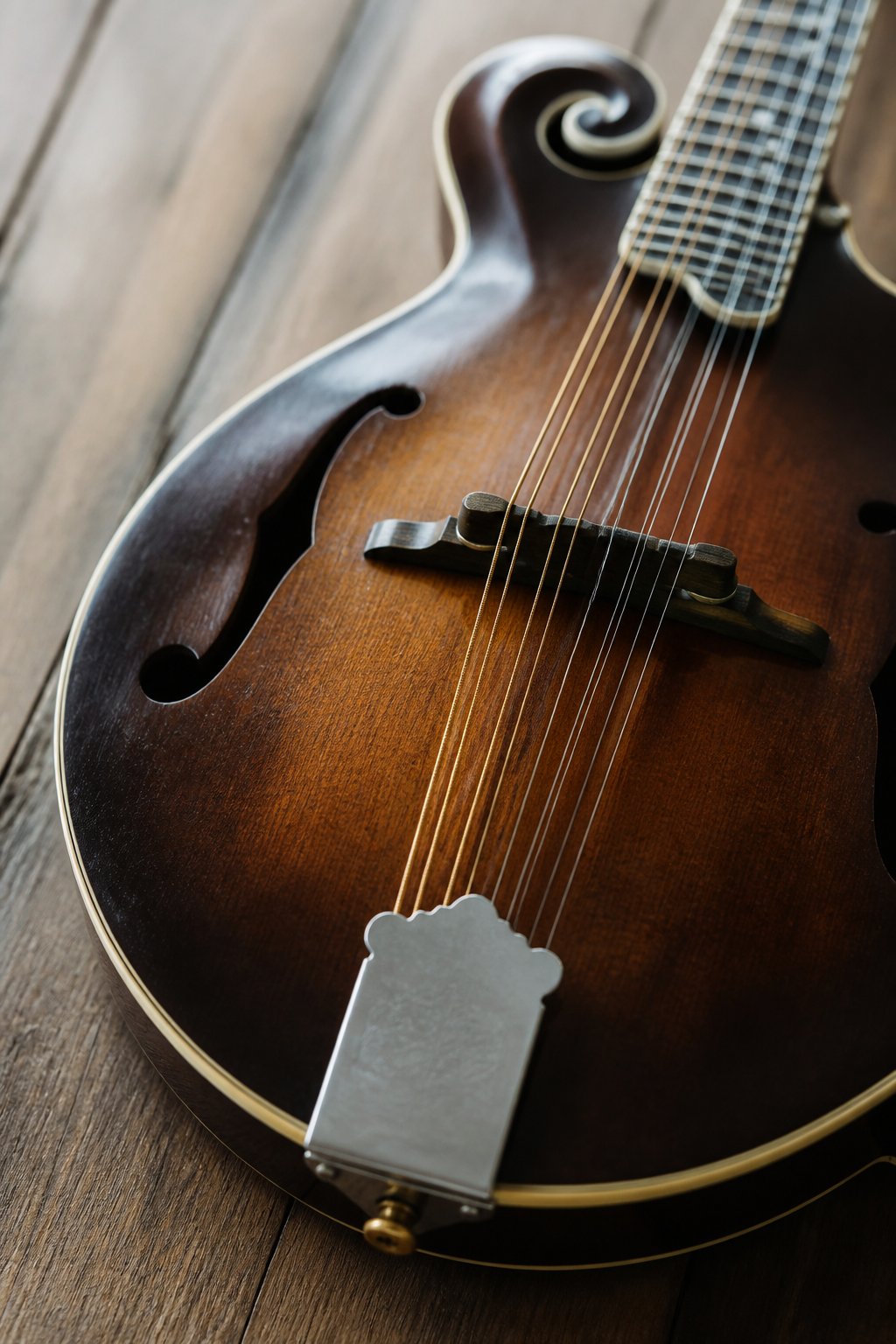
Put a mandolin in a string band and it does two jobs that no other instrument covers. It plays melody in the same range as the fiddle, and on the beats in between it produces the chop: a short, hard, immediately silenced chord on two and four that does exactly what a snare drum would do if bluegrass had ever allowed one. Take the mandolin out of a five piece band and the whole thing sags.
Eight strings, four courses
A mandolin has eight strings arranged in four pairs, called courses. Each pair is tuned in unison and struck as one string, which is why it sounds thicker and slightly out of focus in a way a single string never does. That doubling is the whole tonal signature of the instrument, and it is also why tuning takes twice as long and why a mandolin one hair out of tune with itself sounds unpleasant in a way that a guitar does not.
The scale length is short, around 14 inches, roughly half a guitar. Short scale plus paired strings means high tension on a small body, which is why mandolins are built like small pieces of engineering: carved tops, a floating bridge held down by string pressure alone, and a tailpiece anchoring everything at the bottom.
The mandolin at a glance
- Strings
- Eight, in four unison pairs
- Tuning
- GDAE, same as a fiddle
- Scale length
- About 14 inches
- Bridge
- Floating, adjustable on two thumbwheels
- Standard medium set
- .011 to .041, phosphor bronze
- Right hand
- One plectrum, usually 1 mm or thicker
- Job in the band
- Melody, and the backbeat
Tuned like a fiddle, played like nothing else
The tuning is GDAE in fifths, identical to a fiddle. Everything a fiddler knows about where the notes live applies immediately, which makes the mandolin the easiest second instrument in traditional and bluegrass music. The fingering is completely different, because fifths across four courses put a large stretch between adjacent strings, but the map is the same.
Tuning in fifths has one enormous practical consequence: chord shapes are closed. A mandolin chord uses no open strings, so a single shape slid up two frets becomes a different key with no rethinking. Bluegrass mandolin players transpose faster than anybody else in the circle for exactly this reason, and a beginner who learns four movable shapes can play in every key on the first evening.
The chop, and why bands need it
The chop is the most important thing the mandolin does and the least obvious to a listener, because a chop that is working sounds like percussion rather than a chord.
The mechanics: form a closed chord, usually three or four notes on the middle strings, strike it hard on beats two and four, and release the pressure of the left hand fingers a fraction of a second later so the chord dies immediately. The sound is a short, dry crack with a pitch buried in it. Held even slightly too long, it turns into a chord and the band loses its edge. Struck slightly late, the whole thing drags.
New players usually get the strike before they get the release, and a full year of chopping too long is normal. The fix is to practise the release on its own, without the strike, until the muting hand is automatic.
Bluegrass has no drummer because it already has one, sitting in the middle of the circle holding eight strings and looking innocent.
A style or F style, f-holes or oval
Mandolin shopping means two separate choices that get confused with each other constantly.
Body shape. An A style mandolin has a plain teardrop body. An F style has a carved scroll on the upper bout and two points. The scroll adds a large amount of hand work and therefore a large amount of money, and it does almost nothing to the sound. What it does do is look like the instrument everybody associates with bluegrass, which is not nothing on a stage, but a beginner choosing the F body over a better made A body is buying the wrong thing.
Soundhole. This one genuinely changes the voice. Two f-holes, as on a violin, give a drier, barkier sound with more cut and a better chop, which is why they are standard in bluegrass. A single oval hole gives more sustain, more warmth and a rounder melody tone, which is why they dominate in Irish and old time playing and in Celtic bands generally. If you mostly want to play tunes, the oval hole is a serious contender. If you mostly want to hold down a backbeat in a loud circle, take the f-holes.
The design that fixed the modern instrument came out of Gibson's workshop in the early 1920s, when the acoustic engineer Lloyd Loar signed off a run of F-5 mandolins with f-holes, a longer neck joint and a carved, graduated top. Those Loar signed instruments from 1922 to 1924 remain the reference point, and the bluegrass mandolin sound was built on one of them: the 1923 F-5 that Bill Monroe played for most of his career.
Tremolo and the right hand
A plucked pair of strings on a short scale instrument stops sounding almost immediately. Every mandolin technique is a response to that problem.
- Tremolo. Rapid alternate picking on one note or chord to create the illusion of a sustained line. It is the sound of a mandolin behind a slow song, and it takes months to make even.
- Alternate picking. Down on the beat, up on the offbeat, maintained regardless of which string comes next. The foundation of playing fiddle tunes at speed.
- Crosspicking. A rolling pattern across three strings that imitates a banjo roll, borrowed into bluegrass mandolin from the 1950s onwards and now standard vocabulary.
- Double stops. Two courses at once, usually in thirds or sixths, for harmony behind a singer.
Use a thick plectrum. Anything under about 1 mm bends on the string and robs the attack, and most players end up between 1.1 and 1.5 mm. It is the cheapest change that makes the biggest difference to your tone, and you can test five of them for the price of a pint.
The rest of the family
The mandolin has larger relations, and they turn up constantly in Irish bands and in string bands looking for a fuller bottom end.
| Instrument | Tuning | Where it turns up |
|---|---|---|
| Mandolin | GDAE | Bluegrass, old time, Irish, everywhere |
| Mandola | CGDA | Harmony parts, mandolin orchestras, occasional band use |
| Octave mandolin | GDAE an octave down | Irish bands, backing and countermelody |
| Irish bouzouki | GDAD or GDAE | Rhythm accompaniment in Irish sessions since the 1970s |
Your first three months on the mandolin
- Weeks 1 to 2. Tuning eight strings without losing your temper, plus two closed chord shapes moved up the neck.
- Weeks 3 to 6. Alternate picking on scales in G and D, slowly, with a metronome. Down on the beat every time.
- Weeks 7 to 10. The chop, practised as a release rather than a strike, at a tempo far below anything you would play in public.
- Weeks 11 to 12. One fiddle tune all the way through at a speed where it stays clean, and the beginning of tremolo.
Buying a first mandolin
Below about 150. Skip it. At this level the frets are unfinished, the action cannot be brought down and the tuners will not hold eight strings. It is the single most common reason people abandon the instrument in month two.
Roughly 300 to 600. The real starting point, and the range in which several well known Asian built A style instruments with solid carved tops sit. A solid spruce top matters more than the badge on the headstock. Ask whether the shop has set it up, or budget for a setup.
Roughly 900 to 2,500. Handmade or small workshop instruments, a noticeable jump in volume and separation, and the range where an F style body starts to be a reasonable use of money rather than a decoration tax.
Second hand. Check the neck angle first: sight along the fingerboard to the bridge, and if the bridge is already screwed down to its lowest and the action is still high, the neck has moved and the repair is expensive. Everything else on a mandolin is cheap to fix.
Strings are the other half of the sound, and there is more to it than gauge. We go through materials, tension and how often to change them in mandolin strings for bluegrass.
Common questions
Is the mandolin easy to learn?
The first chords are easy, because four movable shapes cover every key. The melody playing is harder than it looks, because the strings are close together, the frets are small and the paired courses punish imprecise fingering. Most people can play a simple tune in a month and a clean one in a year.
Does a mandolin hurt your fingers more than a guitar?
At first, yes. Eight strings under high tension on a short scale means real pressure on small contact points. It settles within a few weeks, and lighter gauge strings and a proper setup make it far less painful than most people expect.
Should I buy an A style or an F style?
For a first instrument, A style, and spend the difference on build quality or a setup. The scroll is beautiful and it does not make the instrument sound better.
Can I play Irish music on a bluegrass mandolin?
Yes, and plenty of people do. An oval hole instrument suits the repertoire better because it sustains more and barks less, but an f-hole mandolin is perfectly at home in a session, especially once you stop chopping in music that has no backbeat.
How do I tune eight strings without going mad?
Tune the lower string of each pair to the tuner, then tune its partner to it by ear, listening for the beating to stop. Work from the low G course upwards, then go around again, because each pair you tighten pulls the bridge and detunes the last one.
Where to go next
- Mandolin strings for bluegrass, gauges, materials and how often to change them.
- The fiddle, the same tuning and the same tunes, with a bow instead of a plectrum.
- The five string banjo, the other half of the rhythm section in a string band.
- How a bluegrass jam actually works, where the chop earns its keep.