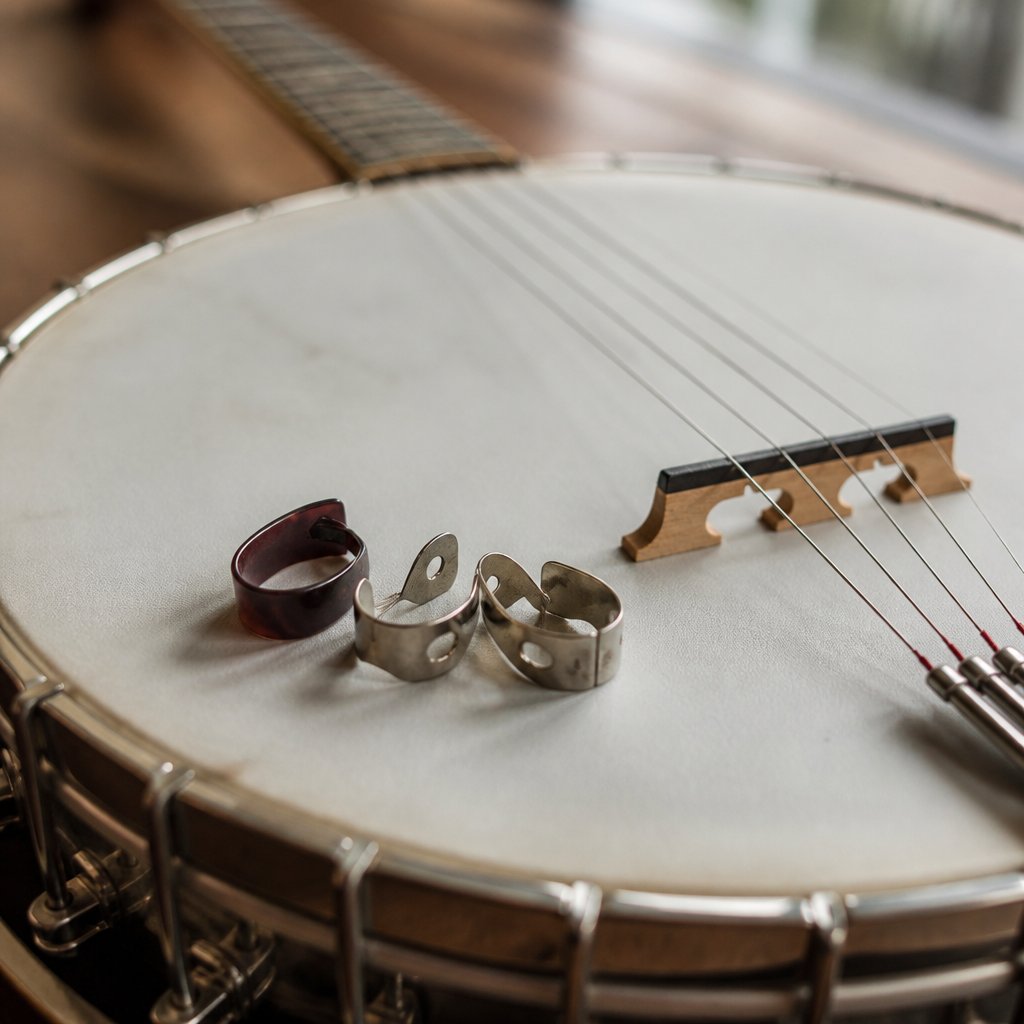
One instrument, two completely unrelated right hands. A clawhammer player strikes downwards with the back of the hand and uses no picks at all. A three finger player wears three picks and moves upwards through repeating patterns that never stop. They produce different music, they suit different instruments, and trying to learn both in the same month is the reliable way to learn neither.
This page sets them side by side so you can choose on purpose rather than by accident.
The two hands, side by side
| Question | Clawhammer | Three finger |
|---|---|---|
| Direction | Down, with the back of the nail | Up, with the pad and the pick |
| Picks | None | Thumb and two fingers |
| Fingers used | One striking finger, plus the thumb | Thumb, index and middle |
| Core pattern | Note, brush, drone | Rolls of eight notes to the bar |
| Usual instrument | Open back, light, no tone ring | Resonator, tone ring, heavy |
| Home repertoire | Old time and Appalachian tunes | Bluegrass, from the 1940s on |
| First month | Musical quickly | Awkward for weeks |
What the clawhammer hand does
The hand is held loosely, curled, knuckles up. The nail of the index or middle finger, whichever you find natural, strikes downward through a single string. The hand keeps moving and the same finger brushes across several strings. On the way back up, the thumb catches the fifth string and lets it ring.
That is the figure everyone writes as bum ditty: a melody note, a brush, a drone, repeated as the engine of the tune. In four four time it occupies one beat and a half of the next, and once it is automatic you stop thinking about it entirely and simply move the melody note around inside it.
Two things extend it. Drop thumb means the thumb reaches strings other than the fifth, which lets melody notes appear in places the striking finger cannot reach. Double thumbing is a regular alternation of the two. Together they turn a rhythmic accompaniment into something that can carry a fiddle tune note for note.
The style is old. Downstroke banjo playing was being written into published tutors by the middle of the nineteenth century, and its roots run back through minstrel era stage banjo to the gourd instruments brought to the Americas by enslaved West Africans. Clawhammer is not a simplified version of bluegrass banjo. It predates it by about a century.
What the three finger hand does
The thumb wears a plastic pick, the index and middle wear metal picks bent over the fingertips. Those three fingers play repeating patterns called rolls, almost always eight notes to the bar, in a stream that continues whether or not the melody needs it.
Three rolls carry the entire style for the first six months.
- The forward roll. Thumb, index, middle repeated across the strings. The most driving of the three and the one that sounds most like bluegrass to a stranger.
- The backward roll. The same fingers in the other order, middle, index, thumb, which throws the accent somewhere else entirely.
- The alternating thumb roll. The thumb returns every other note, alternating between low strings and the fifth, which produces the pulse behind a huge amount of the repertoire.
The melody is not played on top of the roll. It is picked out from inside it: certain notes in the stream are the tune, the rest are filler, and the listener's ear separates them by accent and register. This is the part beginners find genuinely strange, and it is the reason three finger playing takes longer to sound like music.
The style crystallised in North Carolina in the 1930s and 1940s, out of local three finger picking traditions, and reached a national audience when Earl Scruggs joined Bill Monroe's Blue Grass Boys in December 1945. Two later dialects grew out of it: melodic style, which plays scale runs using consecutive strings so the notes overlap, and single string style, which picks a line the way a flatpicker would.
Clawhammer sounds like a tune with a rhythm attached. Three finger sounds like a rhythm with a tune hidden in it. That is the whole difference, and it never goes away.
How they actually sound different
Note density is the first thing you hear. A three finger banjo produces a continuous stream of eighth notes, and the drive comes from that unbroken forward motion. A clawhammer banjo produces gaps, and the drive comes from the accent pattern inside them, which is closer to a drum than to a piano.
The second difference is where the melody sits. Clawhammer buries it in the rhythm, and old time tunes are often played thirty times through with tiny variations rather than arranged into breaks and choruses. Bluegrass banjo separates the roles: back up the singer, take a solo when the circle offers you one, hand it on.
The third is volume, and it is a practical matter rather than a musical one. Metal picks on a resonator banjo are loud enough to cut through a full band with no microphone. Bare fingers on an open back are not, which matters in a jam and not at all in a kitchen.
Do you need different instruments
No, but you will want to eventually. Any five string banjo can be played either way. An open back is lighter, quieter and more comfortable to sit with, and it flatters clawhammer. A resonator banjo with a cast tone ring is louder, brighter and more directional, and it flatters three finger playing.
Strings and setup diverge slightly too. Clawhammer players often prefer a slightly higher action and a fractionally looser head, and many use lighter gauge strings or, on some instruments, nylon. Three finger players usually want the head tight and the action low. None of this is a barrier to swapping styles on one banjo, and every part of it is adjustable, which is covered in the setup section of the banjo guide.
One thing does differ physically: nails. Clawhammer needs a striking nail on one finger that is strong enough to survive, and players who cannot grow one use a plastic fingerpick worn backwards or an artificial nail. Three finger playing needs no nails at all, since the picks do the work.
Choosing, honestly
- Learn clawhammer if you want to play tunes on your own, you like modal and old time repertoire, you want to sing over your own accompaniment, or you have a bad back and do not fancy five kilos of resonator banjo.
- Learn three finger if you want to play in a bluegrass band, you like the sound of a rolling banjo behind a singer, or the reason you bought a banjo in the first place was a bluegrass record.
- Either way, give it six months before you reconsider. The first eight weeks of three finger playing sound bad to everybody, including the people who go on to be very good at it.
Can you play both
Yes, and a lot of experienced players do. The two hands do not interfere with each other once each is properly established, because they use different muscles and different mental models.
The order matters though. Almost everyone who plays both learned one to a reasonable standard first, then added the other, usually eighteen months to two years later. Learning both from zero at the same time means neither becomes automatic, and the whole point of a right hand pattern is that it stops requiring attention so the head is free for the tune.
There are also two finger old time styles, thumb lead and index lead, which sit between the two and are worth knowing about. They are rarer, they suit certain tunes beautifully, and nobody should start there.
Common questions
Is clawhammer easier than three finger banjo?
Easier to start, not easier overall. A clawhammer player can produce a recognisable tune in a few weeks. Getting a clawhammer hand to sound sophisticated, with drop thumb, dynamics and variation, takes just as long as anything in bluegrass.
Is frailing the same as clawhammer?
In ordinary use, yes. Some players draw a fine distinction about whether the brush is included, but if somebody says frailing at a session they mean the downstroke style.
Can you play bluegrass with clawhammer?
You can and people do, particularly in bands that want an older sound. You will be quieter than a picked banjo and the phrasing will not match a Scruggs style break, which some bands love and some will find distracting.
Which style should a complete beginner learn first?
Whichever produced the sound that made you want a banjo. That sounds like a dodge and it is the only answer that survives contact with reality: motivation beats strategy over a first year, and both styles reward the same amount of work.
Do I need two banjos?
No. One banjo plays both. If you end up devoted to one style, the second instrument becomes obvious a year or two in, and by then you will know exactly what you want.
Where to go next
- The five string banjo, explained properly, the instrument underneath both styles.
- Reading banjo tablature, where roll patterns and clawhammer figures are written down.
- How to tune a five string banjo, including the old time tunings clawhammer players use constantly.
- Beginner banjos in the UK and Ireland, open back or resonator, and what each costs.