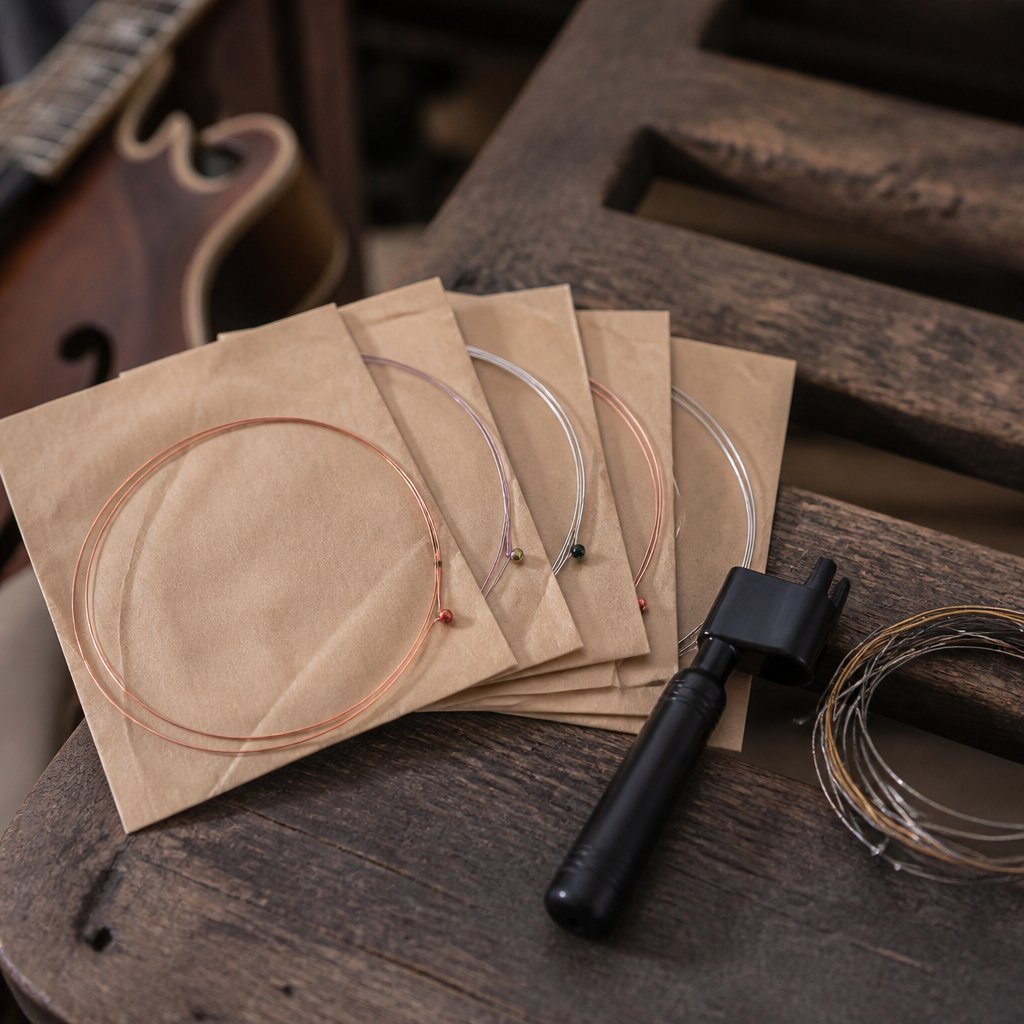
Eight strings, four pairs, and more argument per millimetre than any other component on any instrument in this music. The short version: for bluegrass, phosphor bronze mediums, roughly .011 to .041, changed considerably more often than you are currently changing them. The rest of this page is why, and when to depart from it.
Gauges
Mandolin sets are sold as light, medium or heavy, and the numbers refer to the diameter of each string in thousandths of an inch, quoted from the thin E course down to the wound G.
| Set | Range | Feels like | Best for |
|---|---|---|---|
| Light | .010 to .038 | Easy on the fingers, quieter | Beginners, delicate instruments, Celtic melody playing |
| Medium | .011 to .041 | Firm, loud, a solid chop | The bluegrass standard |
| Heavy | .0115 to .041 and up | Stiff, very loud, tiring | Hard hitting rhythm players on strongly built instruments |
Medium is the default for a reason. The chop, the percussive closed chord on beats two and four that gives a bluegrass band its backbeat, needs tension behind it. Light strings chop politely. Mediums crack.
Two situations argue for lights. First, a beginner in the first months, when the fingertips are still building up and eight strings under tension is genuinely painful. Second, an old or lightly built instrument, where medium tension across a carved top is more load than the maker intended. If the instrument is over about seventy years old or the top is noticeably thin, ask a repairer before fitting mediums.
Materials
- Phosphor bronze. The standard. Warm, full, holds its tone for a reasonable time, and what almost every bluegrass mandolin in these islands has on it right now.
- Eighty twenty bronze. Brighter and more brilliant when new, and it fades noticeably faster. Some players love the first week and change strings weekly to keep it.
- Nickel and monel. Mellower, less zing, and they last a long time. A good answer for players whose sweat kills bronze in a fortnight, and increasingly popular with people who dislike the brittle top end of a new bronze set.
- Flatwound. Smooth, quiet, very long lasting and expensive. Rare in bluegrass and common in Celtic and classical playing, where the reduced finger noise matters more than the volume.
- Coated strings. A microscopically thin polymer layer that keeps sweat and dirt out of the winding. They last two to three times longer, cost roughly double, and sound slightly less bright when new. For anyone playing daily in a humid climate, the maths works.
Loop end or ball end
Almost every mandolin uses loop end strings, which hook over pins in the tailpiece. A small number of instruments take ball ends. Check before you buy, because the two are not interchangeable and a loop end string cannot be improvised into a ball end one.
If the tailpiece cover keeps falling off while you fit them, you are not doing it wrong. Every mandolin player has spent five minutes on the floor looking for one.
Changing them without moving the bridge
This is the part that goes wrong, and it goes wrong once per player. The bridge on a mandolin is not glued: it is held in position by string pressure alone. Take all eight strings off at once and it falls over, and putting it back in exactly the right place is a fiddly job involving harmonics and swearing.
- Mark the bridge position first. A strip of masking tape on the top against the treble foot, or a pencil line, takes ten seconds and removes the entire risk.
- Change one course at a time, or even one string at a time. Seven strings still under tension will hold the bridge exactly where it was.
- Wind neatly, two to three turns down the post with no overlaps. Untidy winding is a spring that keeps releasing for a week.
- Stretch each string by lifting it away from the fingerboard, then retune. Repeat until lifting it no longer drops the pitch.
- Cut the ends short and bend them away. Mandolin string ends are sharp and they sit exactly where your right hand rests.
- Check the intonation when you are done: the harmonic at the twelfth fret should match the fretted note. If it is sharp, the bridge needs to move very slightly away from the neck.
A mandolin with new strings sounds like a different instrument, which is flattering for about ten days and misleading for the whole of the first one.
How often to change them
More often than a guitarist would. A mandolin has a short scale and paired strings, so the intonation and brightness fall off audibly as the windings clog.
For someone playing an hour a day, four to eight weeks is realistic. For a player doing a few hours a week, three months. For a working band, before every recording and roughly monthly otherwise. The signals that a set is finished are a dull top end, tuning that will no longer settle across a pair, and a chop that has gone soft.
Body chemistry varies enormously and it is not a myth. Some players kill a set in ten days through sweat acidity alone, and for them coated strings or monel are worth the extra money. Wiping the strings down with a dry cloth after playing is free and roughly doubles their life.
What to keep in the case
- A spare pair of E strings. The first course is the one that breaks, almost always at the loop, almost always the night before something matters.
- A full spare set, because you will need it at a festival where the nearest shop is fifty miles away.
- A peg winder and wire cutters. Eight strings by hand is a long evening.
- A dry cloth for wiping down after playing, which costs nothing and postpones the next change.
Common questions
What gauge strings should I use on a bluegrass mandolin?
Mediums, roughly .011 to .041, in phosphor bronze. They give the tension the chop needs and the volume a jam needs. Beginners can start on lights for the first few months while the fingertips toughen up.
How often should I change mandolin strings?
Every four to eight weeks with daily playing, every three months or so with occasional playing, and before any recording. Dull top end, unstable tuning within a pair and a soft chop all mean the set is finished.
Can I use guitar strings on a mandolin?
No. The gauges are wrong, the lengths are wrong and most guitar strings are ball end where a mandolin needs loop end. Buy a mandolin set, which costs less than a guitar set anyway.
Why do my E strings keep breaking?
Usually at the tailpiece, where the loop sits over a hook, or at the nut if the slot is rough. Check the hook for a burr, ease the nut slot if the break is always at the same point, and stop tuning up past pitch and back down.
Are coated strings worth it?
If your sweat kills a set in a fortnight, yes, easily. If you change strings monthly anyway and prefer a bright new set, no. They cost about double and last two to three times as long, so the arithmetic depends entirely on your hands.
Do the two strings in a pair have to be identical?
Yes. Both strings in a course are the same gauge and tuned to the same note. Any deliberate detuning between them turns a mandolin into a chorus pedal, which is not the sound this music wants.
Where to go next
- The mandolin, the full guide to the instrument these strings are going on.
- How a bluegrass jam actually works, where a fresh set and a hard chop earn their keep.
- The fiddle, tuned identically, and the instrument you will be playing in unison with.
- Beginner banjos in the UK and Ireland, for the same argument about setup applied to a different instrument.