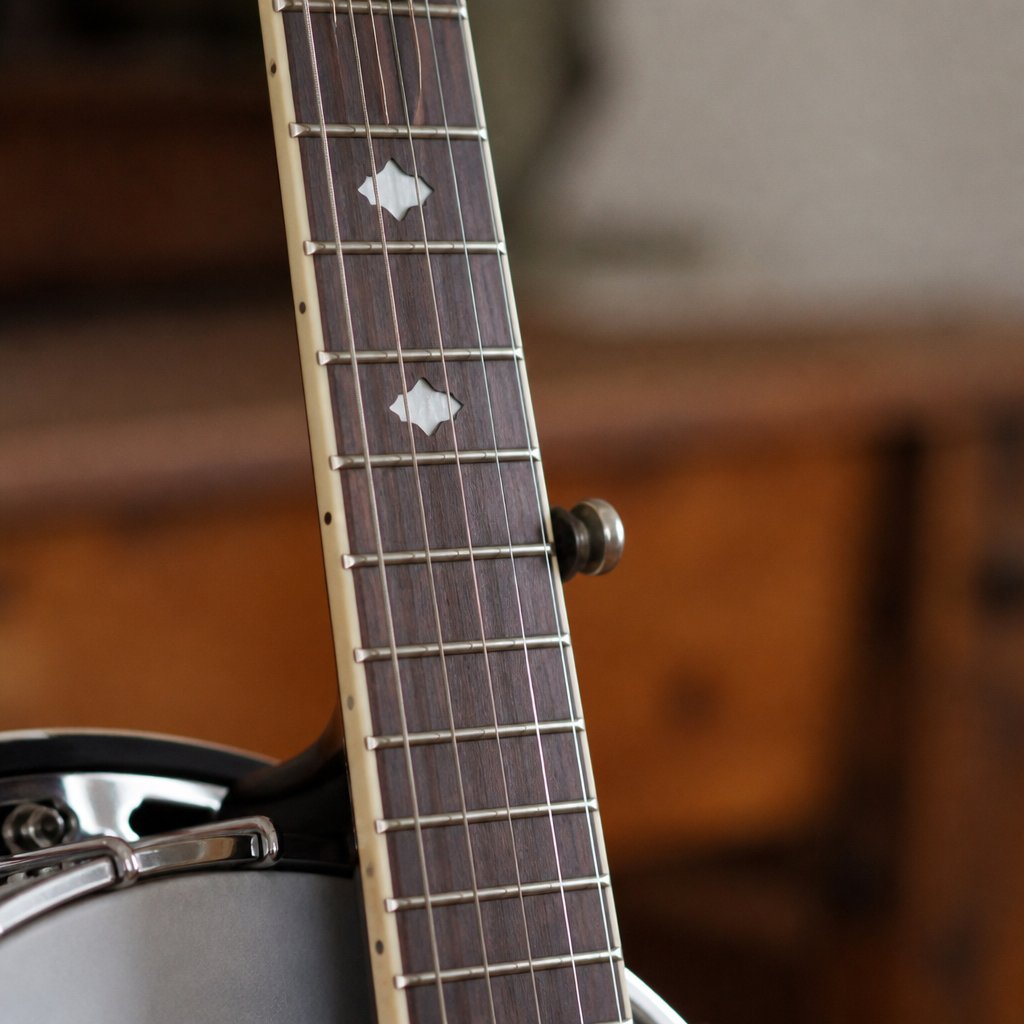
Almost everything that makes the five string banjo sound like itself comes from two design decisions: a drum instead of a wooden soundbox, and a fifth string that is shorter than the others and sits where you least expect it. Understand those two things and the instrument stops being strange.
The string that gives it the name
A guitar has six strings that all run the length of the neck. A five string banjo has four that behave normally and one that does not. The fifth string starts at the fifth fret, has its own tuning peg mounted in the side of the neck, and is the highest sounding string on the instrument even though it sits closest to your thumb, above the low fourth string.
It is a drone. In most playing it is never fretted at all: the thumb strikes it open, over and over, and it rings the same high g against whatever the other strings are doing. That constant note is why a banjo sounds like a banjo rather than a small loud guitar, and it is also why the instrument is so at home in the keys of G and C.
The design is old and it is African in origin. The gourd lutes brought to the Americas by enslaved West Africans carried a short thumb string, and it survived every later change to the instrument: the wooden rim, the metal hardware, the frets, the mass production of the nineteenth century, and the bluegrass banjo of the 1940s.
Standard bluegrass banjo at a glance
- Strings
- Five, one of them short
- Tuning (open G)
- gDGBD
- Scale length
- About 26 1/4 inches, 22 frets
- Head
- 11 inch plastic, tensioned by hooks
- Bridge
- Floating, usually 5/8 inch tall
- Typical light set
- .010 .013 .016 .024 wound .010
- Right hand
- Thumbpick and two fingerpicks
Open back or resonator
Look at the back of a banjo and you are looking at the single biggest fork in the road.
A resonator banjo has a wooden bowl bolted to the back. The bowl catches the sound that would otherwise escape behind the player and throws it forward, which makes the instrument louder, brighter and much more directional. Add the cast metal tone ring that the head sits on and you have the bluegrass banjo: a machine designed to be heard over a fiddle, a mandolin and a guitar with nobody using a microphone. It is also heavy. A fully specified bluegrass banjo can weigh more than five kilos, and you feel every gram of it after two hours standing up.
Open back banjos leave the back of the rim exposed. Less volume, less brightness, more of a woody thump, and often no tone ring at all, which takes kilos off the weight. This is the old time instrument, the one used for clawhammer playing, and it is far more comfortable to sit with. It is also generally cheaper for the same build quality, because the tone ring is one of the most expensive parts of a banjo.
Neither is a beginner version of the other. Choose by the music you want to play, not by price: if the sound in your head is a hard driving five piece band, you want a resonator, and if it is a single voice and a rhythmic, modal, slightly hollow accompaniment, you want an open back.
The bowl on the back of a bluegrass banjo is not decoration. It is the reason a banjo can be heard in a car park at midnight from thirty metres away.
The two right hands
The left hand on a banjo is not much harder than on a guitar. The right hand is where the two traditions separate completely, and where beginners lose months by trying to learn both at once.
Three finger picking, the bluegrass hand
The thumb, index and middle finger wear picks: a plastic thumbpick and two metal fingerpicks worn upside down over the fingernails. Those three fingers play repeating patterns called rolls, most commonly eight notes to the bar, in a continuous stream that never stops even when the melody does. The melody is picked out of that stream by accent and by which string the thumb lands on.
The core rolls are the forward roll, the backward roll and the alternating thumb roll, and they are the entire vocabulary for the first six months. Earl Scruggs did not invent the idea of three finger banjo, but the version he brought to a national audience in the 1940s is the one every bluegrass player is still working from.
Clawhammer, the old time hand
No picks at all. The hand is held in a loose claw, the index or middle fingernail strikes downward through a melody string, the whole hand brushes the strings on the way through, and the thumb catches the fifth string on the way back. That gives the rhythmic figure everybody writes as bum ditty: note, brush, drone, repeated forever.
Clawhammer is easier to make a musical noise with in week one and much harder to make sound sophisticated in year three. Three finger is the opposite: awkward at first, then it opens out. Our comparison of the two goes into what each style can and cannot do: see clawhammer or three finger.
How it is tuned
Standard tuning is open G, written gDGBD. The lower case g is the short fifth string, and the capital letters run from the fourth string across to the first. Strum all five strings open and you get a G major chord, which is exactly why so much banjo music lives in G.
Old time playing uses other tunings constantly, and they change the character of the instrument more than a capo ever will: double C, sawmill or mountain minor, and open D all turn up at any session where the tunes are older than the twentieth century. The step by step method, by ear and with a clip on tuner, is in how to tune a five string banjo.
One warning that saves a lot of frustration: a capo raises the four long strings and does nothing at all for the fifth, because the capo cannot reach it. Every banjo player deals with that eventually, and there are three standard fixes. They are covered in the capo guide.
The parts, named
Shops and forums assume you know the vocabulary. This is the short version.
- Head. The drum skin, almost always plastic now, usually 11 inches across. Frosted heads sound warmer, clear heads brighter. Tension is adjustable and it matters enormously.
- Rim. The wooden cylinder underneath the head, normally laminated maple. The structural heart of the instrument.
- Tone ring. A heavy cast ring, usually bell brass, that the head is stretched over. Flathead and archtop are the two profiles, and the flathead is the standard bluegrass sound.
- Brackets, hooks and nuts. The row of metal fittings around the rim that pull the tension hoop down and tighten the head.
- Bridge. A small three footed piece of maple, often with an ebony top, held in place by nothing but string pressure. It is not glued and it can be moved, which is a feature, not a fault.
- Tailpiece. Anchors the strings behind the bridge. How hard it presses down changes the tone noticeably.
- Armrest. A curved bar over the edge of the head. It keeps your forearm off the head, which stops the sound being muffled and stops the head being ruined by sweat.
- Fifth string peg and nut. The peg is in the side of the neck at the fifth fret and the tiny nut next to it is easy to break, so treat it gently.
Not the same as a tenor banjo
If you have been to a session in Ireland you have heard a banjo playing reels at speed, and it was probably not this instrument. The Irish session banjo is a tenor banjo: four strings, no drone, a shorter neck of 17 or 19 frets, tuned GDAE an octave below the fiddle, and played with a plectrum rather than fingerpicks. It is a melody instrument that plays the tune, note for note, alongside the fiddles and flutes.
The five string banjo on this page is a different job entirely: it accompanies as much as it leads, and it fills space rather than doubling a line. Both are worth playing. Just be clear which one you are buying, because the two are frequently listed under the same word in shop windows and on auction sites.
Your first three months
Fifteen honest minutes a day beats two hours at the weekend, and the order of work matters more than the number of hours.
- Weeks 1 to 2. Tuning, and the G, C and D7 chord shapes. Nothing else.
- Weeks 3 to 6. One roll pattern, or the bum ditty figure, played slowly to a metronome until it is boring, then slower.
- Weeks 7 to 10. Two simple tunes all the way through, badly, from memory. Playing something imperfectly beats practising fragments perfectly.
- Weeks 11 to 12. Play with another human being, at any speed, even if you only manage the chords.
Buying a first banjo
Prices move, so treat these as bands rather than quotes, and check what the shops are actually asking today.
Under about 150. Avoid. At this level the tuners slip, the action is unplayably high and the instrument cannot be set up into something enjoyable. More people quit because of a bad first banjo than because of a lack of talent.
Roughly 300 to 600. The sensible starting range. Instruments here are properly fretted, hold their tuning and respond well to a professional setup. Many have a lightweight tone ring or none at all, which is perfectly fine for a first year.
Roughly 700 to 1,600. A real bluegrass banjo with a full cast tone ring, or a good handmade open back. This is where most players stop, and plenty never need more.
Second hand. The best value in the whole instrument market, because banjos are frequently bought with enthusiasm and sold after eighteen months barely marked. Check the neck is straight, the fifth string peg turns smoothly, the head has no dents around the edge and the rim has no cracks. Everything else is adjustable.
And budget for the setup rather than the badge. A 400 instrument that has been properly adjusted will beat an unadjusted 900 one for enjoyment every day of the week.
The five setup jobs
- Bridge position. Measure from the nut to the twelfth fret, then set the same distance again from the twelfth fret to the bridge, and adjust by ear until the fretted note at the twelfth matches the harmonic. If the fretted note is sharp, move the bridge away from the neck.
- Head tension. Tighter gives more volume and crack, looser gives more warmth and less sustain. Tighten in small even steps around the whole rim, never all at one point.
- Action. Many players end up around 1/8 of an inch, roughly 3 mm, between the first string and the top of the twelfth fret. Lower is easier and buzzes sooner.
- Nut slots. If the first fret feels stiff, the slots are probably cut too high. This is a job for a repairer, not a file and a hopeful evening.
- Fresh strings. The cheapest improvement available. Old banjo strings go dull long before they break.
Common questions
Is the banjo harder than the guitar?
Easier to start, harder to finish. The chords are simpler and the open tuning is forgiving, so the first recognisable tune arrives sooner than it would on guitar. The right hand patterns then take much longer to become automatic than strumming does.
Can I play bluegrass on an open back banjo?
Yes, and people do. You will be quieter than the rest of the band and less bright, which matters in a loud jam and matters not at all at home. The reverse is also true: clawhammer sounds excellent on a resonator banjo, it is just heavier to hold.
Do I have to wear picks?
For three finger playing, effectively yes. Bare fingers cannot get the volume or the attack, and switching to picks later means relearning the feel. For clawhammer, no, picks are not used at all.
How long before I can play with other people?
Three to six months of regular practice is realistic if you can hold down G, C and D and keep a steady rhythm. You do not need to be able to take a break. You need to be able to keep time and stop when everyone else does, which is a separate skill covered in how a bluegrass jam actually works.
How often should I change strings?
Every month or two if you play daily, longer if you do not. Change them before a recording or a festival rather than the night before, and stretch them in properly so they hold pitch.
Where to go next
- How to tune a five string banjo, the note by note method and the alternate tunings.
- Reading banjo tablature, and the timing information tab leaves out.
- Beginner banjos in the UK and Ireland, what to look at in each price band.
- The mandolin, the other instrument that drives a string band.