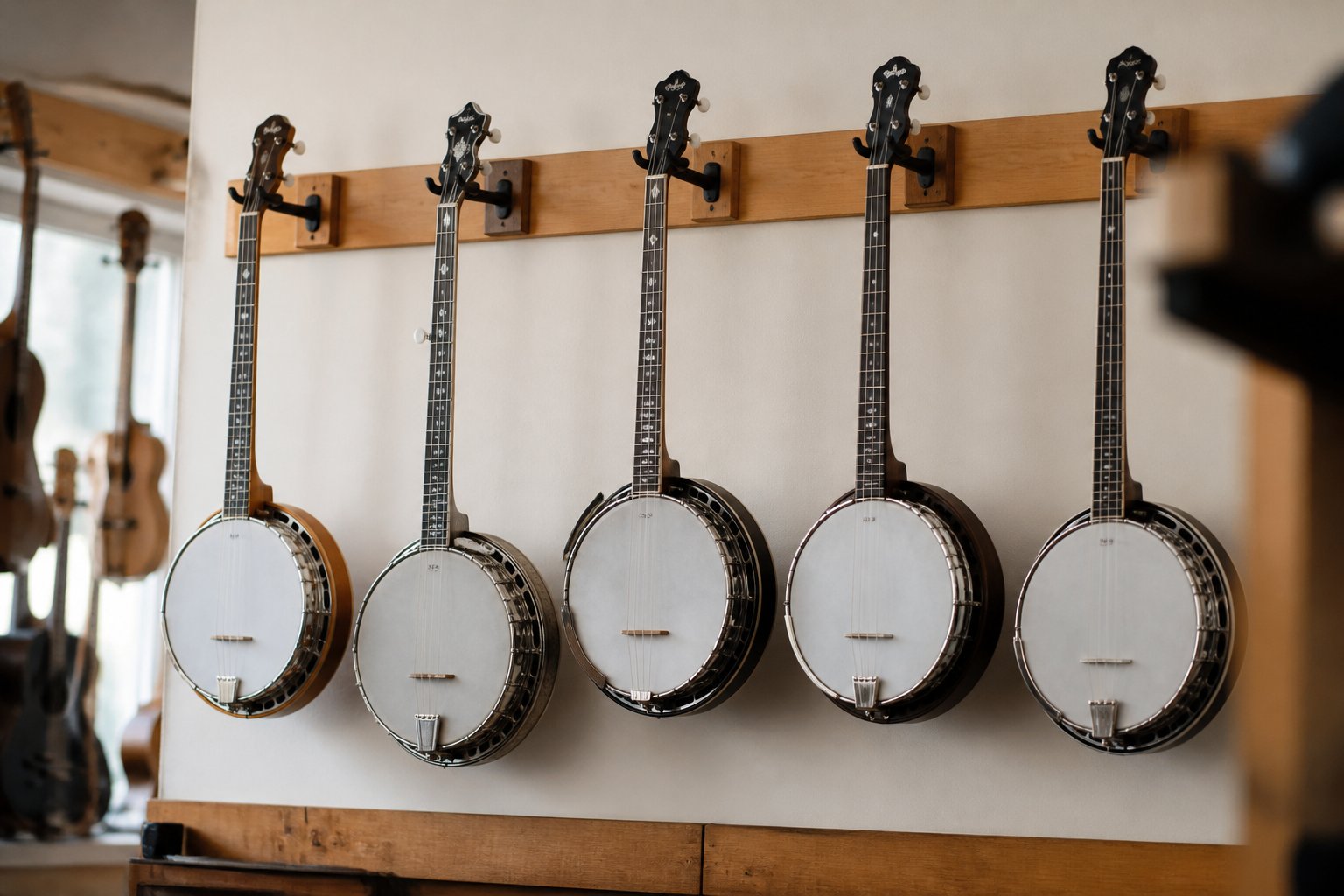
Most people who give up on the banjo give up on a bad one. Not an inexpensive one, a bad one: an instrument with tuners that will not hold, a bridge in the wrong place and an action so high that fretting the third fret is a workout. The difference between the two is roughly a hundred pounds and one visit to somebody who knows how to set a banjo up.
This page is about what to buy in the UK and Ireland, what each price band actually gets you, and how to avoid the traps that are specific to buying here rather than in the United States.
Decide this before you look at prices
Open back or resonator. Everything else follows from it.
A resonator banjo has a wooden bowl bolted to the back and usually a heavy cast tone ring. It is loud, bright and directional, and it is the bluegrass instrument. It is also heavy, frequently over five kilos, which matters if you plan to stand up for two hours.
An open back banjo leaves the back exposed, usually has no tone ring, weighs half as much and sounds warmer and softer. It is the old time and clawhammer instrument, it is far more comfortable to sit with, and for the same money it is generally better made, because the tone ring is one of the most expensive components on a banjo.
If you do not know which style you want to play, read clawhammer or three finger first. Choosing the instrument before the style is how people end up with a heavy resonator banjo they never take anywhere.
The price bands, honestly
| Band | What you get | Verdict |
|---|---|---|
| Under 150 pounds | Unbranded imports, soft metal tuners, high action, often no usable setup possible | Avoid |
| 150 to 300 pounds | Entry level from established brands, playable after work, heavy for the money | Only second hand |
| 300 to 600 pounds | Properly fretted, geared tuners that hold, responds well to a setup | The sensible start |
| 600 to 1,200 pounds | Real tone ring or a good handmade open back, noticeably better hardware | Buy once |
| Over 1,200 pounds | Full bluegrass specification, or a workshop built open back | Not a first banjo |
In euro terms, add roughly fifteen to twenty per cent to those figures for Irish retail, which reflects both currency and a much thinner market for five string banjos on this side of the water.
The instruments people here actually recommend
We take no commission from anybody, so this list is short and unenthusiastic where it should be.
- The American made entry level open backs. One Californian maker in particular has built a straightforward, lightweight open back for decades, and it is the default recommendation in nearly every British and Irish shop for good reason: it holds its tuning, it is light, and the resale value is excellent because everybody wants one second hand.
- The same maker's resonator version. The identical instrument with a resonator and a slightly heavier build. A sensible bluegrass starter that does not pretend to have a tone ring it does not have.
- Composite rim lightweight banjos. Under two kilos, aimed at travel and at players with shoulder problems. They sound thinner than a wooden rim and they are genuinely useful if weight is your limiting factor.
- Far Eastern built banjos from the established import brands. In the 300 to 600 band these are good value, particularly the open backs, and several are sold under British house brands by the larger folk instrument retailers.
- Anything unbranded under 150 pounds. Not a bargain. The money saved goes straight back out on a setup that often cannot fix the underlying problems.
We deliberately do not print model numbers, because the specifications behind them change without warning and a page full of them is out of date within two seasons. Walk into a shop, say what you have read here, and ask them to show you the three instruments they would sell to a beginner.
A well set up banjo at four hundred pounds is a better instrument than a neglected one at nine hundred. This is not a consolation prize, it is simply how banjos work.
What a setup actually includes
Ask any shop whether the price includes a setup, and if the answer is vague, assume it does not. A proper banjo setup is between one and two hours of work and normally costs somewhere in the region of fifty to a hundred pounds.
- Bridge placement. Set by measuring the nut to twelfth fret distance and repeating it, then adjusted by ear until the fretted twelfth matches the harmonic.
- Head tension. Tightened evenly around the rim to a consistent pitch, which changes the volume and the crack of the instrument more than most components.
- Action. Adjusted at the coordinator rod or neck brace, commonly to around three millimetres at the twelfth fret on the first string.
- Nut slots. Cut to the correct depth so the first fret is not stiff. This one genuinely needs a professional.
- Tailpiece pressure and fresh strings. The last five per cent, and both make an audible difference.
Buying second hand
The used market is the best value in the whole instrument world, because banjos are bought enthusiastically and sold eighteen months later barely marked. Check five things and ignore the cosmetics.
- Is the neck straight? Sight down it from the headstock. A slight forward curve is normal, a twist is not.
- Does the fifth string peg turn smoothly? It is the most abused part on the instrument and the fiddliest to replace.
- Is the head undamaged? Dents around the edge and a stretched centre mean it needs replacing, which is cheap, but a cracked rim underneath is not.
- Is there rust on the hardware? Rust on hooks and brackets suggests a damp shed, which is bad news for the wood.
- Does it come with a case? A hard case is worth a hundred pounds on its own and its absence is a real cost.
In Ireland the small ads sites carry a steady trickle of five string banjos, usually from people who tried it. In Britain the choice is far wider and the specialist shops take trade ins. Both markets favour patience: the instrument you want appears every few weeks.
Buying across the Irish Sea
Worth knowing before you press the button. Since the start of 2021, an instrument bought from a seller in Great Britain and shipped to the Republic of Ireland is an import: Irish VAT is charged at the border, customs duty may apply depending on where the instrument was manufactured rather than where the shop is, and the courier adds a handling fee on top. A banjo that looked like a bargain at 500 pounds can arrive costing well over 700 euro.
Two ways round it. Buy from a seller inside the European Union, where nothing changes, or buy from Northern Ireland, which for goods purposes still moves freely to the South. Plenty of players in the Republic simply drive north for exactly this reason.
Going the other way, from Ireland to Britain, the same logic applies in reverse and UK VAT and handling are charged on arrival.
What to buy alongside the banjo
- A clip on chromatic tuner. Twelve to twenty pounds, and the single most useful accessory you will own. See the tuning guide for why chromatic mode matters.
- A capo, and eventually fifth string spikes fitted by a repairer, which the capo guide explains.
- Picks, if you are playing three finger: one plastic thumbpick and two metal fingerpicks, a few pounds, and buy several sizes because fit is everything.
- A cradle strap. Banjos hang badly on a guitar strap. A proper banjo strap that cradles the rim costs twenty to forty pounds and saves your back.
- A spare bridge and a spare set of strings, which live in the case and cost almost nothing.
Common questions
What is the best banjo for a beginner in the UK?
The honest answer is a well set up instrument in the 300 to 600 pound band from an established brand, open back for old time playing and resonator for bluegrass. Below that range the instruments cannot be adjusted into something enjoyable, and above it you are paying for tone rather than playability.
Can I learn on a cheap banjo from an online marketplace?
You can try, and many people do. The risk is that a banjo which cannot be set up properly makes you think you have no aptitude, when in fact the nut slots are too high and the bridge is in the wrong place. If you already own one, spend fifty pounds having it looked at before you decide anything.
Do I need a resonator to play bluegrass?
Not to learn. You need one to be heard in a jam or a band. At home an open back is quieter, lighter and often better built at the same price.
Should I buy new or second hand?
Second hand, if you can take somebody who plays with you. Banjos hold up well and depreciate sharply, so the used market gives you roughly a band and a half more instrument for the same money.
How much should I budget in total?
For a realistic start, think of the instrument plus about 150 pounds: setup, tuner, strap, capo, picks, spare strings and a case if one is not included. Building that into the plan stops the instrument budget being spent entirely on the instrument.
Where to go next
- The five string banjo, explained properly, the parts, the tuning and the five setup jobs in detail.
- Clawhammer or three finger, the choice that decides whether you want an open back or a resonator.
- How to tune a five string banjo, the first thing to do with a new instrument.
- Festivals in Ireland and Britain, where the instrument tables and repairers turn up in person.