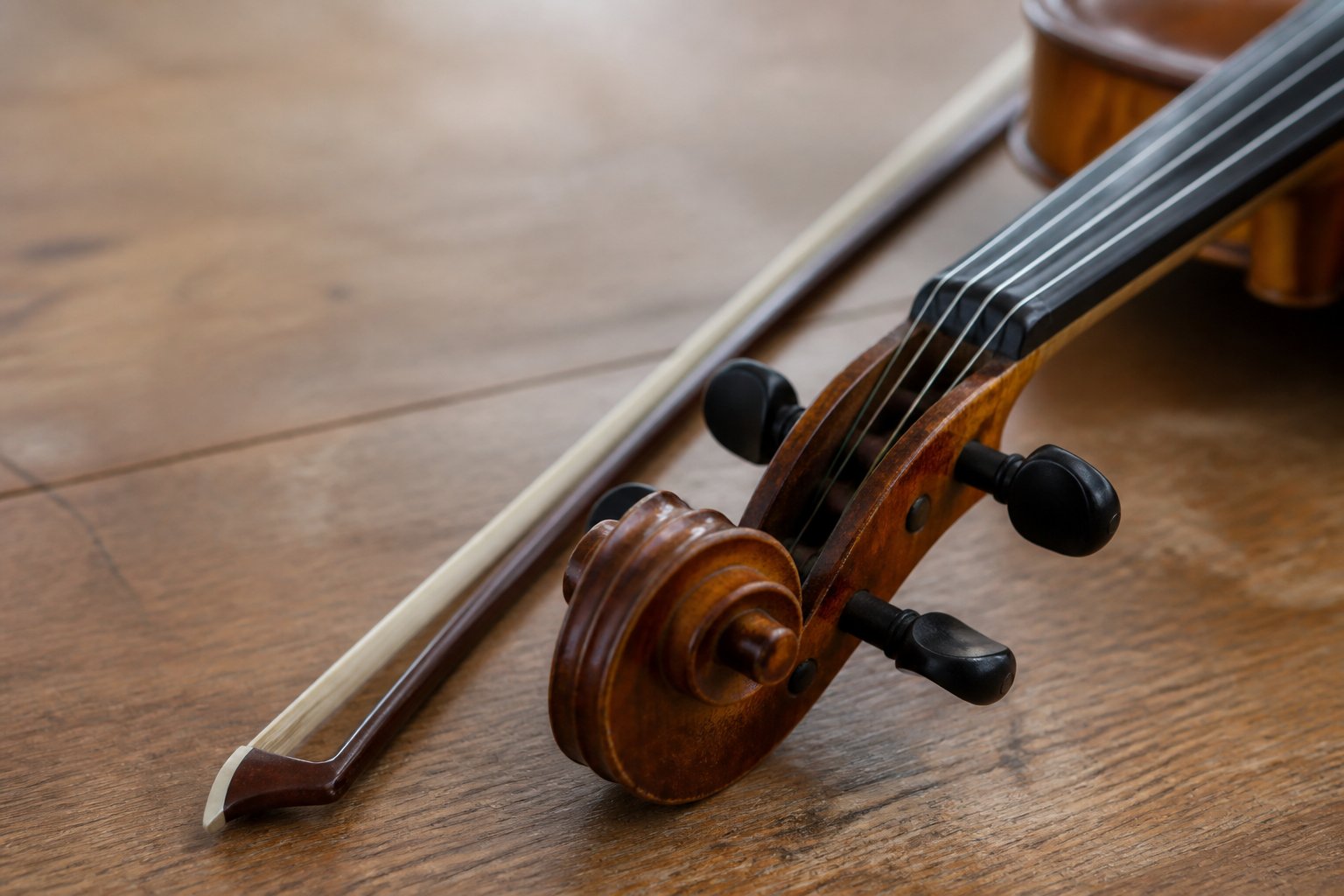
A fiddle is a violin. Same box, same four strings, same tuning, frequently the same instrument bought in the same shop. What changes is everything around it: how it is set up, how the bow is used, what is played on it, and whether the player is aiming for a long singing line or a rhythm you could dance to. In traditional Irish music and in Appalachian old time, the fiddle is not an ornament on the top of the band. It is the band's oldest member.
The same box, a different job
Nothing about the construction of a fiddle differs from a violin. The differences that do exist are adjustments, and every one of them is reversible.
Many traditional players prefer a slightly flatter bridge, because a lower arch across the four strings makes it easier to sound two strings at once, and double stops and drones are the backbone of both Irish and old time playing. Steel core strings are common where classical players would use synthetic core, partly for the brighter attack and partly because they hold up in a pub in February. Plenty of players use no shoulder rest at all and hold the instrument lower, against the collarbone or even the upper arm, which sacrifices left hand freedom high up the neck in exchange for comfort over four hours. Since traditional playing lives almost entirely in first position, that is a cheap trade.
None of this is a rule. Sit in any session in Ireland and you will find a classically trained player with a full shoulder rest and a Baroque bridge next to somebody playing a factory fiddle held like a banjo, and they will be perfectly in time with each other.
The fiddle at a glance
- Strings
- Four, tuned in fifths
- Tuning
- GDAE, low to high
- Same as
- Mandolin, note for note
- Frets
- None at all
- Bow
- About 75 cm, roughly 60 g, horsehair
- Typical trad keys
- D, G, A, E minor
- Position used
- First, nearly always
How it is tuned
Four strings in fifths: GDAE, from the thick string nearest your chin side to the thin one. That is the same set of notes as a mandolin, which is the single most useful fact for anyone playing traditional music, because every tune written for one instrument fits the other without transposing. Fiddle players who pick up a mandolin already know where the notes are. The reverse is also true, and it is the reason so many bluegrass bands contain one person doing both.
The keys follow from the tuning. Irish traditional music sits overwhelmingly in D and G, with a strong second tier of A and E minor, because those are the keys where the open strings ring underneath the melody. Old time playing goes further and retunes the instrument entirely, which is covered below.
The bow does the work
Beginners assume the left hand is the hard part because it is the visible part. It is not. On a fiddle the left hand chooses the notes and the right hand decides whether it is music.
The bow supplies the rhythm, the accents and most of the ornamentation. In Irish playing, a great deal of what sounds like fast finger work is actually bow work: the bowed triple, three quick strokes on one note, and the pattern of slurs that gives a reel its lift. In old time playing the bow is even more openly rhythmic. The shuffle patterns, long stroke followed by two short ones, repeated across a tune, are what makes an old time fiddle sound like a dance band rather than a melody instrument, and they are why an old time fiddler can hold a room together with no other instrument present.
A tune played with the right notes and the wrong bow is not the tune. A tune played with a few wrong notes and the right bow still gets people dancing.
Irish playing, and its regions
Irish traditional fiddling is a single note melody line, decorated rather than harmonised, played in unison by everyone in the session. Because there is no harmony to hide in, the decoration carries the personality, and there is a whole vocabulary for it.
- The cut. A flick of a higher finger that interrupts a note without changing it. The most common ornament in the tradition and the hardest to hear at first.
- The tap or pat. The same idea from below, a finger dropped briefly onto the string.
- The roll. A cut and a tap wrapped around one long note, turning it into five events without changing the pitch.
- The treble. Three fast bow strokes on a single note, used for drive rather than decoration.
- The slide. Arriving at a note from below, more common in the southwest than anywhere else.
The regional styles are real, and they are still audible even after a century of recordings flattening everything. Donegal playing is fast, comparatively unornamented and heavily single bowed, with Scottish forms such as highlands and mazurkas in the repertoire. Sligo playing, exported worldwide by the fiddlers who recorded in New York in the 1920s and 1930s, is fast, flowing and richly ornamented. Clare playing is generally more relaxed in tempo with an emphasis on lift. The Sliabh Luachra area on the Cork and Kerry border keeps a repertoire of polkas and slides, played with double stopping that is unusual anywhere else in Ireland.
Tune types matter as much as keys. A reel is in four, a jig in six eight, a slip jig in nine eight, a hornpipe in four with a swing on it, a polka in two four. If somebody at a session calls a set of jigs and you start a reel, everyone will know within one bar.
Old time and bluegrass
The Appalachian tradition and the Irish one are cousins rather than twins. The emigration that carried Scottish and Ulster fiddling to the American mountains carried the repertoire and the bowing habits, then two hundred years of separation, African American banjo rhythm and different dance forms did the rest.
The biggest practical difference is retuning. Old time fiddlers change the tuning of the whole instrument to suit a tune, which puts different open strings under the melody and turns the fiddle into a drone machine.
| Tuning | Notes | Usually for |
|---|---|---|
| Standard | GDAE | Everything in Irish music, and most bluegrass |
| Cross A | AEAE | Tunes in A, with drones above and below the melody |
| Open G | GDGD | Tunes in G, big open sound, common with a banjo in double C |
| High bass | ADAE | Tunes in D and A that need a fuller bottom end |
| Dead man's tuning | DDAD | A small group of well known modal tunes, unmistakable once heard |
Bluegrass fiddling is a third thing again. It came out of the same repertoire but grew a blues vocabulary: double stops in thirds and sixths, slides into notes, and the kickoff, a four bar introduction that sets the key and the tempo and tells the whole band that the song has started. In a bluegrass band the fiddle takes turns as a lead instrument and then drops back to long sustained notes behind the singer, which is a discipline in itself. Nothing exposes a fiddler like being asked to play quietly.
The parts, named
- Scroll and pegbox. The carved head and the box holding four friction pegs. Wooden pegs grip by taper alone, so they need pushing in as they turn.
- Fingerboard. Ebony on anything decent, unfretted, curved to match the bridge.
- Bridge. Maple, never glued, held up by string tension, with feet fitted to the exact curve of that instrument's top. It creeps forward over months and needs straightening.
- Sound post. A small dowel wedged between the front and back inside the body. Move it a millimetre and the instrument changes voice. In several languages it is called the soul, which tells you what luthiers think of it.
- Bass bar. A strip glued under the top on the low string side, spreading the vibration.
- Tailpiece and fine tuners. Small screw tuners on the tailpiece do the last few cents of adjustment, which matters enormously with steel strings.
- Chinrest. A clamp on fitting, and the one part that should be chosen to suit your neck rather than left as it came.
Your first three months on the fiddle
- Weeks 1 to 3. Long bows on open strings, listening for a clean tone with no scratch. Boring, and it is the whole game.
- Weeks 4 to 6. First position fingering in D and G. Tape on the fingerboard is fine at this stage and no one serious will mind.
- Weeks 7 to 10. One slow air and one simple polka, both from memory. Reading is optional in this tradition and learning by ear pays for itself later.
- Weeks 11 to 12. Add a bowed rhythm to a tune you already know, and play with a metronome or, better, with a guitar player who will not slow down for you.
Buying a first fiddle
Outfits, meaning fiddle, bow and case together, are how beginner instruments are sold, and it is a sensible way to buy.
Below about 150. The instruments sold at this level online are usually shipped with the bridge unfitted, pegs that will not hold and a bow that cannot be tightened. They are not cheap instruments, they are unfinished ones.
Roughly 250 to 500. A student outfit from a real shop, set up before it leaves the counter. This is the sensible entry point and it will take you several years. Ask specifically whether the shop sets up the instrument, because that work is worth more than the difference between two brands.
Roughly 700 upwards. Better wood, better fittings, and the point at which a fiddle starts to reward a good player rather than merely tolerate a beginner.
Rental. Most music shops in Ireland and Britain rent student outfits by the month and put some of the rent towards a purchase. For an adult who is not certain, this is the least painful route in the whole instrument world.
Whatever you buy, budget for rosin, a spare set of strings and a shoulder rest to try. And have a repairer check the bridge and sound post once, early, because a badly placed sound post makes a good fiddle sound like a bad one.
Common questions
Is a fiddle the same as a violin?
Physically, yes. The word describes the music being played rather than the instrument. A fiddle set up for traditional playing may have a flatter bridge and steel strings, but any violin can be used and any fiddle can be handed back to a classical player.
Can I play Irish tunes on a fiddle if I learned classically?
Yes, and the transition is mostly about the bow and the ear. The notes will be easy. The ornaments, the rhythm and learning tunes without a printed part are the work, and that takes about a year of going to sessions.
Do I need a shoulder rest?
No. Many traditional players use none, some use a sponge, some use a full rest. Try all three for a fortnight each rather than taking anyone's word for it, including ours.
How long before I sound like music?
A clean open string tone takes a few weeks. A recognisable tune takes two to three months. The honest answer for the fiddle is that the first stage sounds worse than on any other instrument in this music, and then it improves faster than any of them.
Should I learn to read music?
It helps and it is not required. Irish and old time repertoire are both transmitted by ear, and most sessions expect you to know tunes from memory. Learning to read notation is useful for picking up a tune quickly from a book, then putting the book away.
Where to go next
- The mandolin, tuned identically, so every tune you learn here transfers straight across.
- The five string banjo, the instrument that supplies the drive while the fiddle carries the tune.
- How a bluegrass jam actually works, including how breaks are handed round a circle.
- Festivals in Ireland and Britain, where the workshops for both traditions happen.